Last updated: October 2026
By Asmmoldremoval
Mold testing at a glance
Mold testing is often presented as the first step whenever a homeowner sees a stain or smells something musty. In practice, the more useful first step is a careful inspection: identify water entry, condensation, humidity, ventilation problems, and visible or concealed mould, then correct the moisture source.
Testing can still answer a focused question when the source or extent is unclear. The right question is not simply “What species is in my house?” It is “What decision will this sample help me make?”
- Routine indoor air testing is usually unnecessary when mould is visible and the moisture source is clear.
- Selective sampling may help investigate hidden growth, unexplained concerns, extensive flooding, roof or pipe leaks, or post-remediation conditions.
- Moisture mapping and building inspection are more important than a species name or a single laboratory number.
- Air, surface, cavity, bulk, and HVAC samples answer different questions and have important limitations.
- Scarborough properties may need particular attention to basements, attics, winter humidity, condensation, and intermittent rain or snowmelt intrusion.
Contents
- What mold testing can and cannot tell you
- When testing helps - and when it does not
- The inspection and testing process
- Testing methods compared
- Why moisture diagnostics come first
- Best practices for reliable decisions
- Mold testing in Scarborough, ON
- Examples of focused investigations
- Post-remediation verification
- Frequently asked questions
- Next steps
What mold testing can and cannot tell you
Mold testing is the collection and laboratory analysis of air, surface, bulk, cavity, or HVAC samples. Depending on the method, a report may describe the types or groups of fungal material detected, the amount collected, or whether material was present at a particular location.
A sample is a snapshot, not a complete diagnosis of a building. It does not by itself prove that a particular mould caused a health symptom, establish a universally safe exposure limit, or identify the moisture source. Health Canada explains that the many mould species and the variability of individual responses prevent the use of a simple residential exposure limit.
For that reason, Health Canada’s residential mould guidance emphasizes controlling humidity, repairing water damage, and thoroughly cleaning visible or concealed growth. A useful report should connect any sampling result to observations at the property and to practical corrective work.
What a useful investigation answers
- Where is moisture entering, accumulating, or condensing?
- Is there visible or concealed mould in an area relevant to the complaint?
- Does the building history suggest a wall cavity, attic, crawl space, or HVAC source?
- What materials need cleaning, drying, removal, or repair?
- Has remediation addressed the visible condition and the moisture cause?
A clear stain with an active leak may need prompt correction rather than a delayed laboratory result. Conversely, a persistent odour with no visible source may justify carefully selected sampling after the inspection has narrowed the search.
When mold testing helps - and when it does not
Testing adds value when it resolves a specific uncertainty. Examples include a musty odour with no visible growth, suspected contamination behind finishes after a leak, extensive flood damage, a dispute about the condition of a property, or a need to document conditions after remediation.
Health Canada’s guidance on moisture and mould states that air testing is not recommended in most situations because it often provides little information about the cause of mould damage or the health effects of exposure. It notes that a qualified professional may consider non-viable air sampling when concerns remain unexplained after inspection, including some situations involving flooding, roof leaks, or pipe leaks that may have affected wall cavities.
Situations where selective testing may be reasonable
- Hidden contamination: An odour, history of water damage, or building pathway suggests growth behind drywall, under flooring, or inside a ceiling.
- Unclear extent: A large or complex water event affects several rooms, materials, or air-handling areas.
- Property documentation: Buyers, sellers, property managers, or insurers need a documented investigation, with the limits of sampling clearly stated.
- Post-remediation review: Visual inspection and moisture checks are complete, but targeted sampling is appropriate for the project’s scope.
When testing is usually not the first move
If mould is clearly visible and the moisture source is known, testing may delay the work that matters. Cleaning or removing affected materials safely, drying the area, and repairing the leak are generally more useful than paying for a species identification that will not change the plan.
Health Canada’s advice on indoor mould similarly recommends finding and fixing moisture problems rather than routinely measuring the concentration or species of indoor mould. A professional should explain why a sample is being proposed and what decision will follow from each possible result.
The inspection and testing process
A responsible mold inspection and testing visit begins with questions and observation, not with a pump or swab. The investigator reviews the building history, occupants’ concerns, leaks, renovations, odours, seasonal patterns, and any previous remediation.
Step 1: Define the concern
The location and timing of the problem matter. An odour that appears when the furnace starts suggests a different investigation from staining that follows a basement storm, while morning attic condensation points toward a ventilation or humidity issue.
Step 2: Inspect visible and concealed risk areas
The inspection may include attics, roof sheathing, plumbing chases, baseboards, exterior walls, crawl spaces, mechanical rooms, HVAC components, and areas around windows. The investigator looks for staining, deterioration, odour, condensation, poor drainage, leaks, and pathways that could move moisture or air.
Step 3: Map moisture
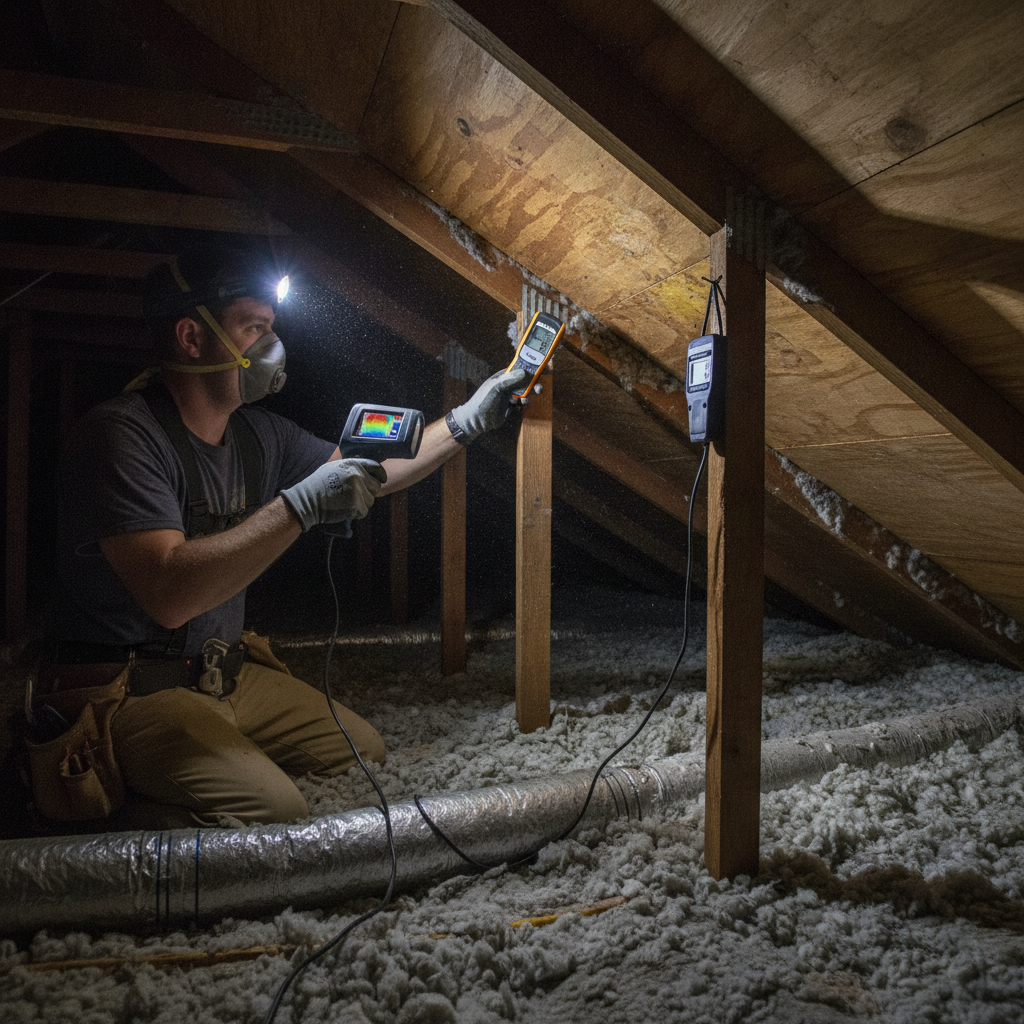
Pin and pinless moisture meters help identify wet or suspect materials, while thermal imaging can reveal temperature patterns associated with missing insulation, air leakage, or moisture. A thermal image is not proof of mould; it is one clue that must be confirmed through inspection and, where justified, further investigation.
Step 4: Choose only necessary samples
Sampling locations should represent the complaint and the suspected source. Depending on the question, a professional may collect an air sample, tape lift, swab, bulk material, cavity sample, or HVAC sample. Every sample should have a stated purpose and documented location.
Step 5: Document and interpret
Samples are labelled and transferred according to the laboratory’s requirements. The final interpretation should combine laboratory findings with photographs, moisture readings, building conditions, and a practical scope of work. A number without context is not a remediation plan.
Health Canada’s guidance for indoor air-quality professionals notes that airborne mould sampling generally does not determine whether remediation is needed. Decisions should be based on a thorough inspection and early correction of moisture and mould, with sampling reserved for situations where the source remains uncertain.
Testing methods compared
No method is automatically “the best” test. Each method examines a different part of the building and should be selected because it answers a defined question.
| Method | What it examines | Useful question | Important limitation |
|---|---|---|---|
| Air sampling | Airborne fungal particles during a specific period | Is there a reason to investigate airborne material when the source remains unclear? | A snapshot affected by activity, HVAC operation, weather, and sampling conditions; it does not establish a health threshold. |
| Tape lift or swab | Material on a selected surface | Is the material on this particular surface consistent with mould? | Represents one location and does not measure the whole room. |
| Cavity sampling | Air or material within a wall or ceiling void | Could a leak have caused concealed growth behind finishes? | Requires careful access and still examines only the selected area. |
| Bulk sampling | A piece of building material | What is present in material already being removed or opened? | May be destructive and often does not change the immediate moisture-control plan. |
| HVAC sampling | Deposits or material near coils, pans, ducts, or registers | Is the air-handling system part of an odour or distribution concern? | Requires interpretation alongside system operation, maintenance, and moisture conditions. |
Surface testing can confirm what is on a surface, but it cannot certify that an entire building is free of mould. Air testing can provide information in a carefully selected investigation, but it should not be treated as a pass-or-fail health test.
Why moisture diagnostics come first
Mould requires moisture, a suitable material, and time. The durable solution is therefore to stop water entry, reduce condensation or humidity, dry affected materials, and remove or clean growth using appropriate containment and filtration.
Common sources include roof or plumbing leaks, foundation seepage, groundwater, poor grading, bath-fan discharge into an attic, blocked or poorly designed ventilation, condensation on cold surfaces, and HVAC drain or coil problems. Relative humidity readings can support the investigation, but one reading cannot describe a whole season or every hidden cavity.
Questions to ask during a moisture assessment
- Is the material currently wet, or is there evidence of a previous event?
- Does the moisture pattern follow a roof, plumbing, foundation, window, or HVAC pathway?
- Could warm indoor air be reaching cold attic or wall surfaces?
- Are exhaust fans vented outdoors and operating effectively?
- Has damaged porous material been dried promptly or does it need removal?
In Ontario, seasonal changes can expose weaknesses that are not obvious on the day of a visit. Winter indoor humidity and attic condensation, spring snowmelt, summer cooling, and heavy rain can each create different moisture patterns.
Best practices for accurate decisions
Before the appointment
- Write down when odours, staining, or symptoms occur and whether they change with rain, heating, or cooling.
- Gather information about leaks, floods, renovations, insurance claims, and previous remediation.
- Avoid disturbing suspected mould unnecessarily before the inspection.
- Ask what the proposed sample will determine and what action would follow each possible result.
During sampling
- Use representative locations rather than choosing only the most visibly damaged spot.
- Record room conditions, HVAC status, temperature, humidity, photographs, and exact sample locations.
- Prevent cross-contamination through clean handling, proper labelling, sealed containers, and a documented transfer process.
- Keep the investigation proportionate: more samples are not automatically better evidence.
When reviewing the report
Look for a plain-language explanation of the question, method, location, limitations, laboratory result, and recommended next step. Be cautious of claims that a single concentration proves a property is safe or unsafe, that a species name alone determines risk, or that testing can replace correcting visible mould and moisture.
The CMHC publication on mould testing and sampling also explains that inspection and correction of moisture problems remain central, and that testing may be considered when the source or extent of contamination is unclear. This is a useful decision rule for homeowners: sample to resolve uncertainty, not simply to create a number.
Tools used in a focused investigation
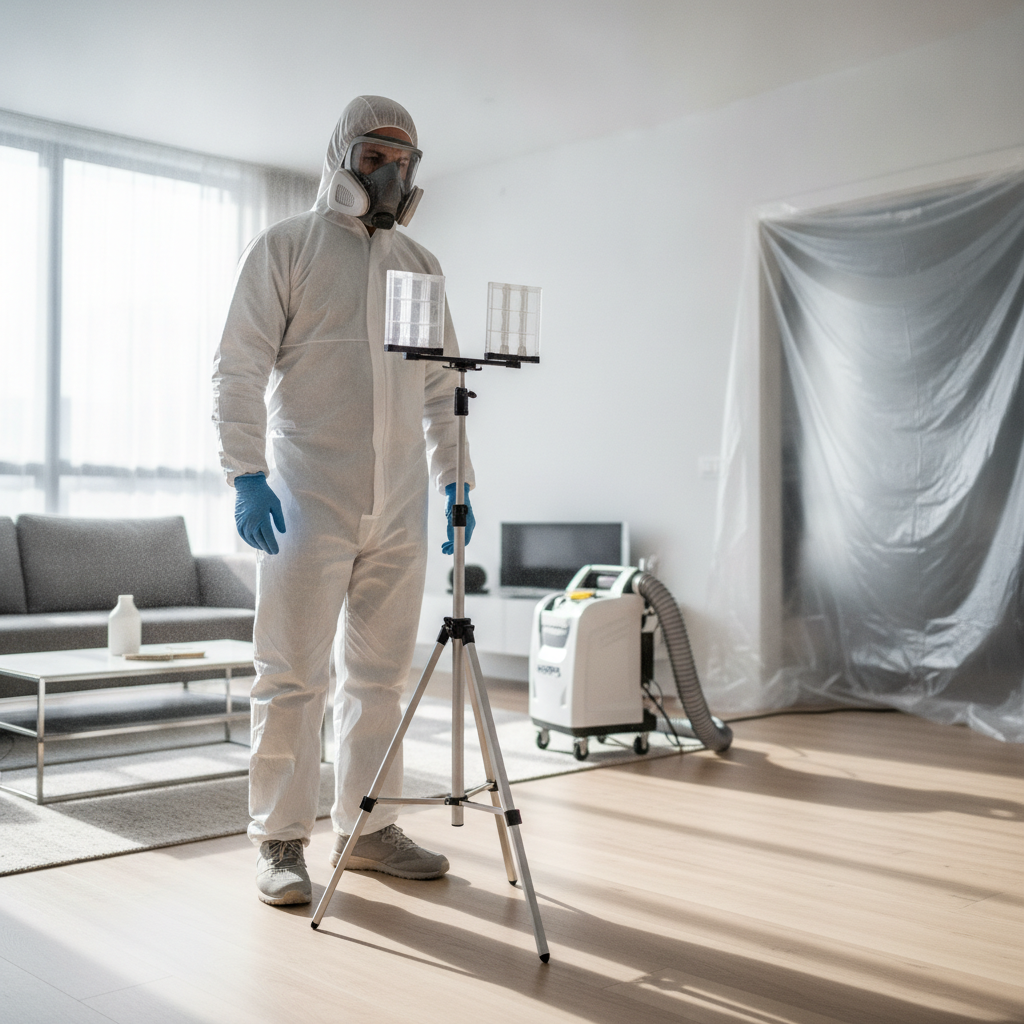
ASM Mold Removal Inc. begins with a free inspection and moisture assessment. Depending on the property, the team may use moisture meters, thermal imaging, air-sampling equipment, surface-sampling supplies, HEPA filtration, containment materials, and protective equipment.
Tools support professional judgement; they do not replace it. A thermal camera can highlight a cold or damp-looking area, while a moisture meter can help compare materials. Neither device independently identifies mould. The useful result is a documented chain from observation to source correction.
For commercial properties such as offices, schools, healthcare settings, warehouses, and retail spaces, planning also considers occupants, operating hours, HVAC zones, access, and disruption. Sampling or intrusive inspection may be scheduled outside peak periods, but urgent leaks and visible growth should not be left unresolved while waiting for a perfect testing plan.

Mold testing in Scarborough, ON
Scarborough homes and businesses can contain a mix of older construction, finished basements, additions, flat or low-slope roof areas, and updated HVAC systems. A local investigation should focus on the actual building rather than assume that every musty odour has the same cause.
Local conditions worth checking
- Attics: Bathroom exhaust routed into an attic, insufficient air sealing, or winter condensation can affect roof sheathing and insulation.
- Basements: Intermittent seepage, foundation cracks, condensation, and finished walls can conceal moisture after heavy rain or snowmelt.
- Older properties: Unsealed chases, aging plumbing, and modified ventilation pathways may move odours or humid air between floors.
- Commercial spaces: HVAC operation, roof assemblies, storage areas, and occupant schedules can change where an investigation should begin.
ASM Mold Removal Inc. is based in Scarborough and provides same-day response across Ontario for urgent leaks, odours, and visible growth. The service covers residential and commercial attics, basements, crawl spaces, HVAC systems, and related repair or restoration needs.
Examples of focused investigations
Attic odour in a semi-detached home
Dark spotting on roof sheathing and a winter bedroom odour led to an inspection of bath-fan routing, attic ventilation, and moisture conditions. The useful action was correcting the fan discharge and improving attic airflow; selective surface or air sampling could document the condition, but a species name would not repair the source.
Finished basement after spring rain
An intermittent odour with no visible staining justified tracing the exterior wall and slab-to-wall joint, checking moisture, and inspecting behind a limited section of finish. If concealed growth was found, targeted removal and drying would be more important than broad room-by-room air testing.
Crawl space with persistent mustiness
A crawl-space investigation may examine ground moisture, ventilation, plumbing penetrations, insulation, and pathways into the living area. Correcting a missing ground barrier or persistent humidity can prevent recurrence; sampling is reserved for a question that remains after those conditions are assessed.
Office odour on HVAC start-up
Inspection should include filters, coils, drain pans, registers, nearby water damage, and system runtime. Surface or HVAC sampling may help if deposits or a concealed source remain uncertain, but cleaning, repair, filtration, and moisture control form the practical solution.
Post-remediation verification
Verification is a documented check that remediation addressed the defined scope. It should include a visual review, confirmation that the moisture source was corrected, assessment of affected materials, and confirmation that work areas are clean and appropriately dry.
Targeted air or surface sampling may be considered when the project scope, building complexity, client requirements, or unresolved concern makes it useful. It should never be the only clearance criterion. If visible dust, damaged materials, active moisture, or odour remains, a favourable sample cannot substitute for more work.
ASM Mold Removal Inc. uses containment and HEPA filtration where appropriate and provides a Mold Remediation Warranty Certificate upon completion and inspection. A clear handoff should also explain prevention measures, maintenance needs, and any areas that were outside the inspected scope.
Frequently asked questions
Is mold testing necessary if I can already see mould?
Usually, not before action when the mould and moisture source are clear. Correct the water problem, clean or remove affected materials safely, and document the work. Testing may be considered if the extent is uncertain, hidden areas are involved, or documentation is needed for a specific decision.
Does Health Canada recommend routine indoor air testing?
No. Health Canada generally does not recommend routine air testing for mould because results do not reliably predict health effects or identify the cause of damage. A qualified professional may consider selective non-viable sampling when concerns remain unexplained after inspection, particularly after certain leaks or flooding events.
Do air samples prove that a home is safe or unsafe?
No. Air samples are snapshots influenced by activity, HVAC operation, weather, and sampling conditions, and there is no simple residential mould limit that converts every result into a safe or unsafe label. Interpretation must include the building inspection, moisture findings, visible conditions, and occupant context.
How long does a mold inspection and testing visit take?
Many residential inspections take about 60 to 120 minutes, but the duration depends on property size, access, moisture history, and whether concealed areas require investigation. Laboratory turnaround varies by the selected method and laboratory. The provider should explain the scope and expected reporting timeline before collecting samples.
Get a moisture-focused mold assessment
If you are in Scarborough or elsewhere in Ontario, begin with a professional inspection and moisture assessment rather than ordering a routine air test without a defined purpose. ASM Mold Removal Inc. can investigate visible or suspected mould, explain whether selective sampling is warranted, and outline remediation, repair, and prevention options.
Request a same-day mold assessment from ASM Mold Removal Inc.


